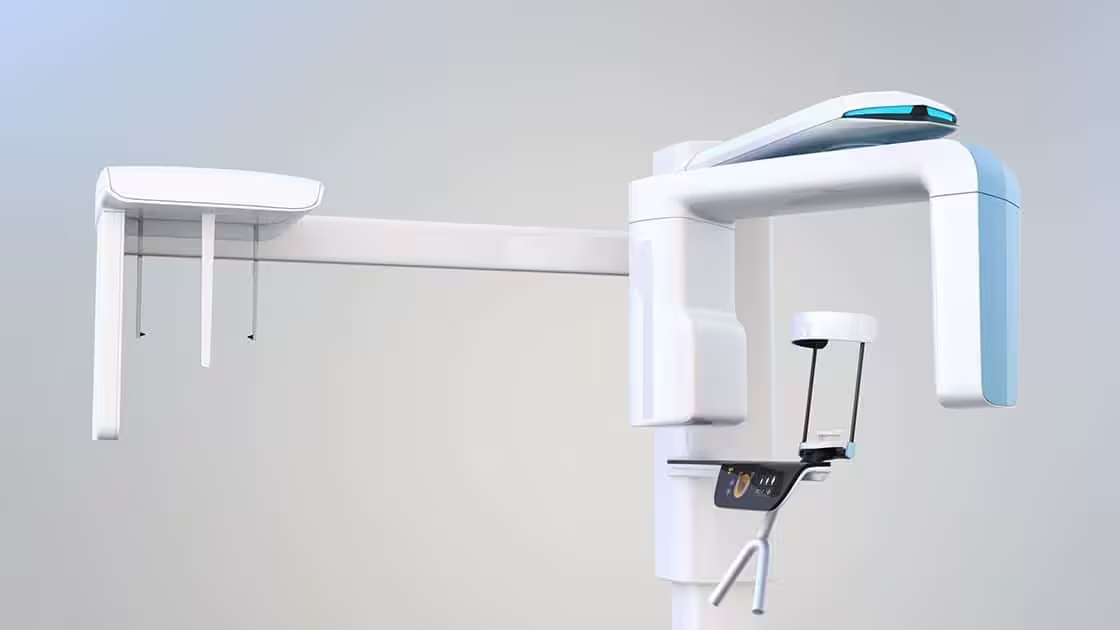
Norwell Oral Surgery and Dental Implant Center utilizes advanced Cone Beam CT scanning to provide detailed three-dimensional images of your jaw, teeth, and surrounding structures. This state-of-the-art technology allows Dr. Helal and Dr. Colton to plan surgical procedures with remarkable precision, leading to better outcomes and shorter recovery times for our patients in Norwell, MA and the surrounding South Shore communities.
Experience the benefits of advanced imaging. Call 781-871-7800 to schedule your appointment.
How CBCT Compares on Radiation Exposure
Radiation safety is a reasonable question to ask about any imaging procedure, and the peer-reviewed literature offers a fairly clear answer for CBCT. Dental CBCT uses a pulsed, narrowly focused beam and a single rotation around the patient, which produces a dramatically smaller dose than a conventional medical CT of the maxillofacial area. One study published in the Journal of Pharmacy and Bioallied Sciences found that the mean effective dose for dental CBCT was roughly 1.8 mSv compared with 2.5 mSv for medical CT scans used for the same dental purposes, with other published reports placing low-dose dental CBCT protocols in the 80–150 microsievert range — orders of magnitude below whole-head medical CT. The literature does note that effective doses from CBCT fall within a fairly wide range depending on the detector, field of view, and voxel size, which is exactly why modern practices select the smallest field of view appropriate to the clinical question and use low-dose settings whenever possible. It is worth being straightforward here: a CBCT does deliver more radiation than a single intraoral or panoramic film, so the decision to take one is always a clinical judgment about whether the added 3D information genuinely changes diagnosis or treatment — a principle the American Dental Association and the American Academy of Oral and Maxillofacial Radiology both emphasize in their guidance on the technology.